
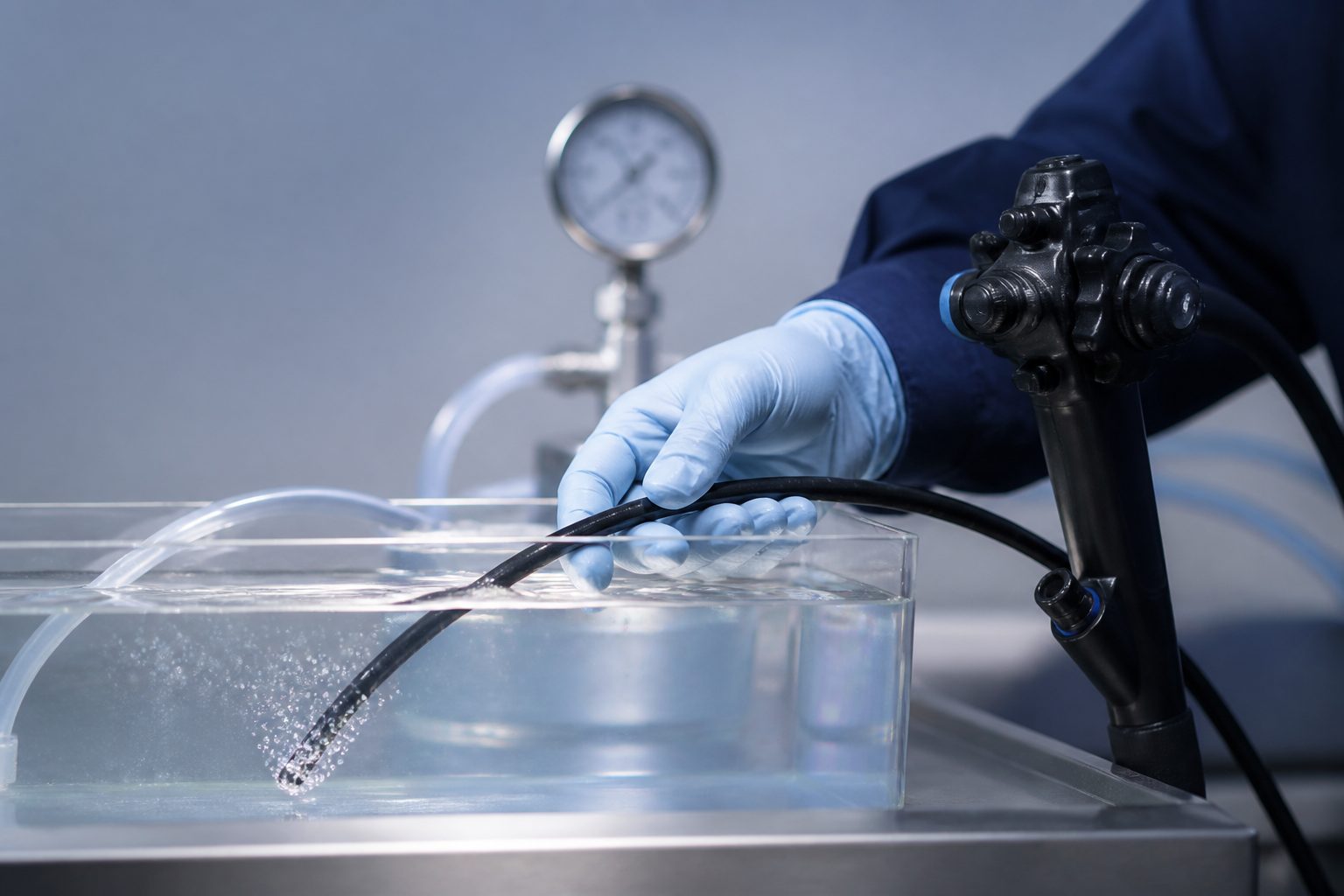
The tip will not reach full deflection or feels loose
Endoscope Angulation Repair When the Tip Will Not Reach Full Deflection
Angulation loss is gradual, so the first person to notice is usually the endoscopist rather than the tech. By the time a scope feels loose on the bench, the steering system has been out of specification for a while.
- Angulation wire and sheath replacement
- Control body, sprocket, and brake service
- Free evaluation and a written quote first
- Pickup in Southern California, mail-in nationwide
Get a Free Repair Quote
Tell us what failed and we will send a written quote before any work begins. No charge for the evaluation, and no purchase order needed to get one.
Quote before any work
You approve a written quote before a technician touches the scope.
Free evaluation
We diagnose the failure and price the repair at no charge, even if you decline.
We come and get it
Pickup and delivery across Southern California, mail-in service everywhere else.
Independent, not the OEM
All major manufacturers serviced, without OEM exchange pricing.
Symptom to cause
What Loss of Tip Deflection Is Telling You
Which direction fails, and whether the control feels loose or heavy, points at a different part of the steering system.
What you see
Both planes deflect less than they used to, evenly, and the wheels feel slack before the tip moves
Likely cause
Angulation wire stretch from normal cycling. Every loop, every retroflexion, and every hard turn adds a little permanent elongation.
What we do
Reset tension where the wire is still within tolerance, and replace the wires and sheaths where it is not. Range is measured against specification afterward.
What you see
The tip reaches full range but will not hold position under load
Likely cause
A worn or contaminated brake mechanism rather than an angulation fault. The wires are doing their job and nothing is holding them.
What we do
Service the brake assembly, replace worn friction components and seals, and confirm the tip holds against the same load it failed at.
What you see
One direction is short and the opposite direction is normal
Likely cause
A single stretched or parted wire, or a sheath crushed on that side. Asymmetric loss is almost always a single component rather than general wear.
What we do
Replace the affected wire and sheath as a pair, then balance tension across the plane so both directions reach their range together.
What you see
Deflection is gritty, notchy, or heavy through the range
Likely cause
Corrosion or debris in the wire sheaths, frequently the first mechanical sign that fluid reached the interior of the scope.
What we do
Assess the interior for fluid damage, replace the corroded wires and sheaths, and clean or replace the sprocket and pulley assembly.
What you see
Deflection fell off right after the insertion tube was crushed or kinked
Likely cause
Wires binding inside a deformed section of tube, or a wire stretched at the crush point while the outer sheath looked survivable.
What we do
Repair the tube and the steering system together. Fixing one without the other puts a new wire through a deformed conduit.
What you see
The control wheels turn freely with no tip movement at all
Likely cause
A parted angulation wire, or a wire that has come off its sprocket inside the control body.
What we do
Open the control section, replace the failed wire and sheath, reseat and retension the drive, and verify the full range in every direction.
What Not to Do With a Scope That Has Lost Tip Deflection
Steering faults are the easiest failure to work around and the most expensive one to keep working around.
- Do not keep running a scope that is short on deflection because the endoscopist can compensate. A stretched wire is already close to its yield point, and the failure that follows is a parted wire with the tip locked in a curve inside a patient.
- Do not force a control wheel past the point where it stops. Whatever is stopping it is either a wire at the end of its travel or a mechanism that is jammed, and forcing it will part the wire or shear the drive rather than free it.
- Do not attempt to adjust angulation tension in the department. The adjustment sits behind seals that are part of the pressure envelope on most scopes, and opening them without resealing and leak testing creates a breach that later shows up as fluid inside the scope.
- Do not lubricate the control wheels or wire path with anything from the shop. Oils and sprays that are fine on general equipment attack the polymer sheaths and the seals, and they carry residue into channels that get flushed against patients.
- Do not store scopes coiled at a tight radius with the tip locked or braked. Both put standing tension on the wires between cases, and stretch accumulates from time under load as well as from use.
Deflection Loss Versus a Slipping Brake, and How to Tell Them Apart
These two complaints arrive worded identically and they are different repairs. Hold the scope with the insertion tube laid straight and turn each control wheel through its full travel with the brake off. Watch the tip against a fixed reference. If the tip reaches the range the specification calls for and simply will not stay there when you let go, the wires are fine and the brake is the fault.
If the tip stops short of its range regardless of the brake, the steering side is the fault. Note which of the four directions fall short and by roughly how much, because an even shortfall in all four points at general wire stretch while a shortfall in one direction points at a single component.
That two minute check changes the quote, so it is worth doing before you call. Everything else on this page assumes you have already separated the two. The other symptom pages in this section follow the same pattern of testing before assuming.
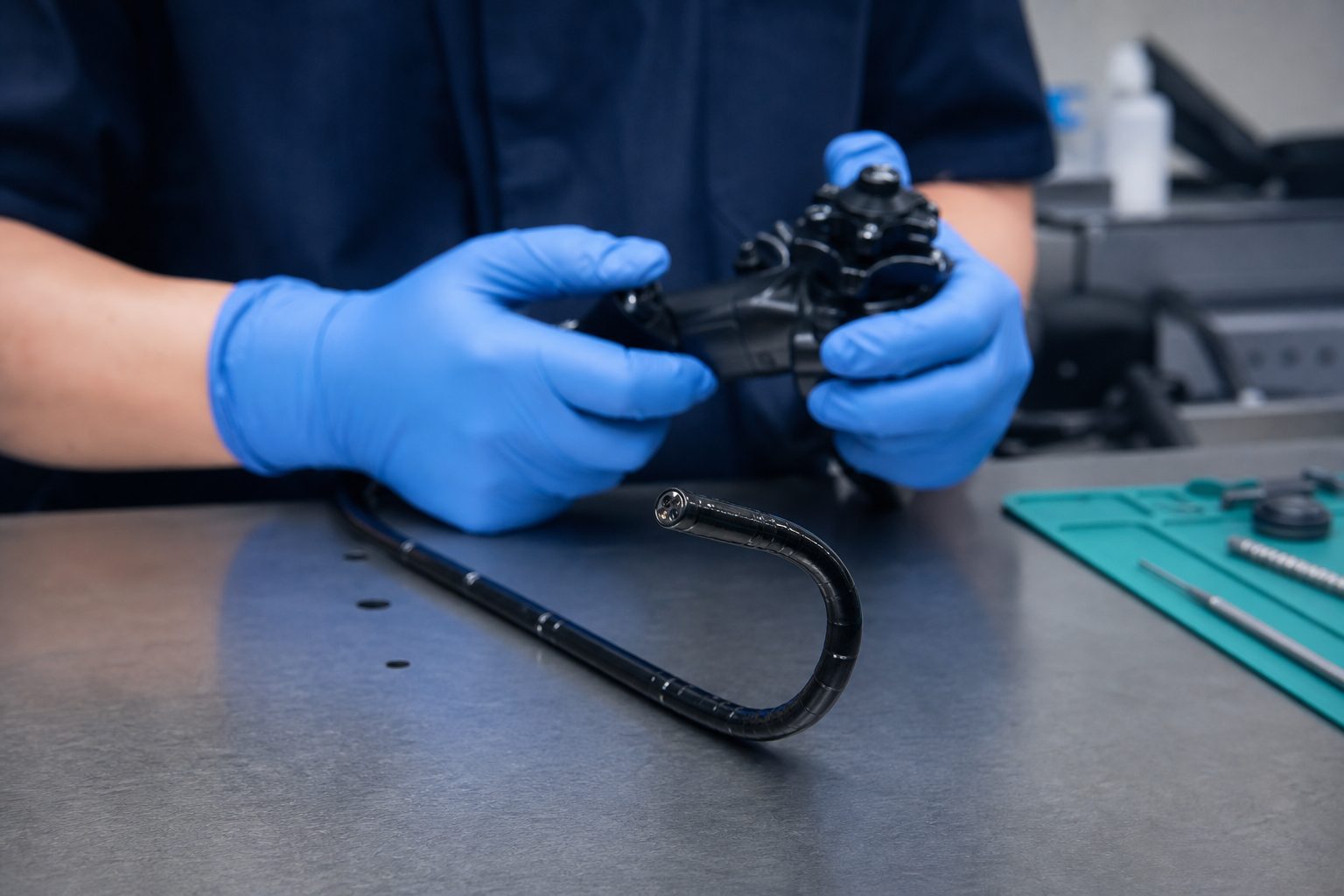
Why Steering Cable Stretch Happens Gradually and Then Suddenly
Angulation wire is stranded stainless running inside a coiled sheath, and it is loaded every single time the tip moves. Each cycle adds a small amount of permanent elongation. For a long time nothing changes that anyone can feel, because the mechanism has tolerance built into it. Then the accumulated stretch consumes that tolerance, and the loss becomes obvious over a few weeks.
The scopes that get there first are the ones that live in retroflexion and in tight loops. Flexible ureteroscopes are the extreme case, because full deflection is the entire point of the device and it is used at the limit of its range on nearly every case. Colonoscopes are close behind for a different reason, which is sheer volume of turns per shift.
Two things speed that up well beyond normal wear. One is any deformation of the conduit the wire runs through, which is why a crush event and a deflection complaint so often arrive together and why the insertion tube damage page is worth reading alongside this one. The other is corrosion, which is a signal that fluid got somewhere it should not be.
Primary and Secondary Tip Deflection, and What Each One Reveals
On a four way scope, the up and down plane carries the working load and the left and right plane assists. The up direction in particular takes the most force, because it is the one used to lift and to retroflex. That is why the up direction is usually the first to come up short, and why an even loss across all four is a different story from a loss in up alone.
Where the device has a secondary bending section, the same logic applies down the chain. Loss in the secondary section with a healthy primary section usually means a wire or sheath problem specific to that run rather than general wear in the control body, and it changes what we open first.
None of this is diagnosed by feel. Range gets measured against the manufacturer specification for the model in all four directions, before the scope is opened and again after it is reassembled. A scope that feels good in the hand and measures ten degrees short is still going to frustrate the endoscopist who called it in.
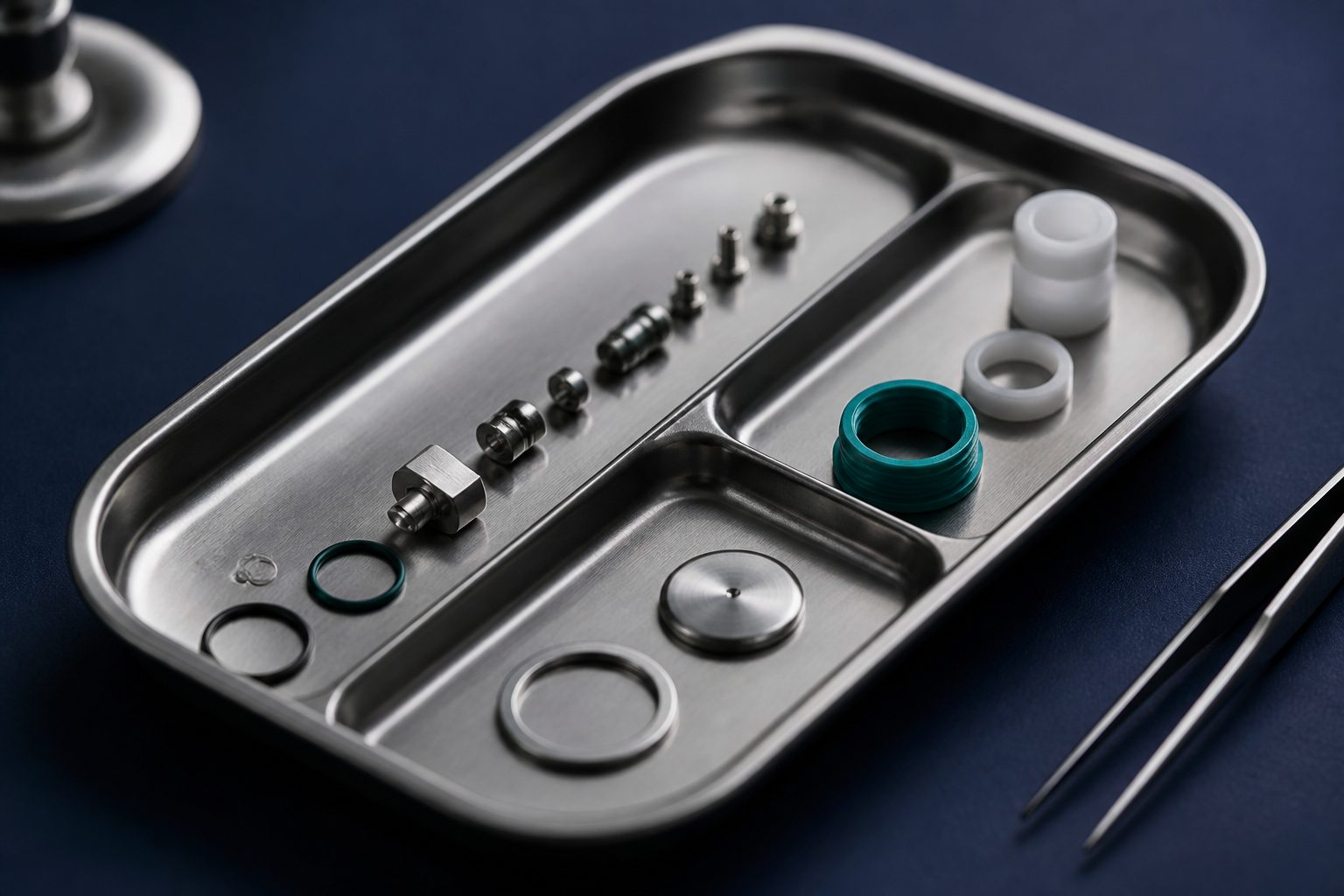
What Angulation Wire Replacement Actually Restores
The repair depends on what the measurement showed. Where wires are within tolerance, the work is tension reset, sprocket and pulley service, and brake restoration. Where they are not, the wires and their sheaths are replaced as pairs so tension balances across the plane, and the control body drive is reseated and retensioned around them.
Because the angulation system runs the full length of the scope, the wire path crosses the bending section, the insertion tube, and the control body. That means the evaluation looks at all three, and it is normal for an angulation quote to include a bending rubber replacement or a tube section. Every flexible scope on our bench is also leak tested at intake and again after reassembly, whatever it came in for. That is standard flexible endoscope service.
The two devices we see most for this fault are flexible ureteroscopes, where deflection is the whole job, and colonoscopes, where volume does the work instead. If the controls feel gritty rather than slack, check the fluid invasion symptoms before you send it, because the timeline on that one is much shorter.
How it works
How Angulation Cable Repair Works on Our Bench
Range is measured against specification in all four directions before and after, not judged by feel.
Tell us what failed
Send the manufacturer, model, and what you are seeing. A photo of the damage helps but is not required.
We collect the scope
Courier pickup across Southern California, or ship the device in to our bench from anywhere in the country.
You get a written quote
We evaluate the device, document the failure, and price the repair. Nothing proceeds until you approve it.
Repaired, tested, returned
The device is repaired, leak and function tested, and returned with documentation for your records.
Questions we get
Angulation Wire Questions From Endoscopy and SPD Teams
How much deflection loss is enough to pull a scope from rotation?
The tip moves fully but will not stay where we put it. Is that the same repair?
Can angulation tension be adjusted without opening the scope?
Deflection went stiff and gritty rather than loose. What does that mean?
Our scope was crushed and lost deflection at the same time. Two repairs or one?
Do you measure deflection against the manufacturer specification?
Other Flexible Endoscope Failures Behind Poor Steering
Deflection problems often start somewhere other than the control body. These are the usual co-conspirators.
Leak Testing
The scope fails a leak test in reprocessing
Fluid Invasion
Fluid has entered the scope body or control section
Cracked Distal Lens
The image is starred, hazy, or partially blacked out
Bent Insertion Tube
The insertion tube is kinked, buckled, or will not straighten
Dim Illumination
The field is dim even at full light source output
Channel Blockage
Air or water will not pass, or insufflation is weak
Biopsy Port
The biopsy port leaks, sticks, or will not seal
Get a Quote on Endoscope Angulation Repair
Tell us the manufacturer, the model, which directions fall short, and whether the controls feel loose or stiff.
Monday to Friday, 8:00 AM to 5:00 PM Pacific
Saturday and Sunday, closed
Mail-in repairs received any day
Serving Southern California with pickup and delivery, and the rest of the country by mail-in.