

The field is dim even at full light source output
Broken Light Fiber Repair When the Field Is Dim at Full Output
Illumination loss gets blamed on the scope more often than any other fault, and the cable is the culprit at least as often. Ten seconds of testing tells you which device to send.
- Illumination bundle repair on flexible and rigid scopes
- Cable bundle replacement and end face repolishing
- Free evaluation and a written quote first
- Pickup in Southern California, mail-in nationwide
Get a Free Repair Quote
Tell us what failed and we will send a written quote before any work begins. No charge for the evaluation, and no purchase order needed to get one.
Quote before any work
You approve a written quote before a technician touches the scope.
Free evaluation
We diagnose the failure and price the repair at no charge, even if you decline.
We come and get it
Pickup and delivery across Southern California, mail-in service everywhere else.
Independent, not the OEM
All major manufacturers serviced, without OEM exchange pricing.
Symptom to cause
What a Dim Image Is Telling You Before You Blame the Scope
Illumination runs through four separate components in series. Each one fails differently, and only one of them is the scope.
What you see
The field brightens noticeably when you swap in a different light cable
Likely cause
The cable is the fault, not the scope. Cable bundles break faster than scope bundles because cables get coiled, dropped, and stepped on far more often.
What we do
Replace the cable fiber bundle or repolish the end faces, then measure transmission against a reference before it goes back to the room.
What you see
A speckled or peppered pattern of dark dots visible on the illuminated light post
Likely cause
Individual broken fibers across the bundle face. Each dark dot is a fiber that no longer carries light, and the count only ever goes up.
What we do
Replace the bundle where the loss is past useful transmission. There is no repair that restores a broken fiber, so the honest options are replace or continue.
What you see
A dark ring, wedge, or crescent at the edge of the illuminated field
Likely cause
A localized break in the bundle, usually at a tight bend point behind a connector or where the cable was crushed in a door or a cart.
What we do
Assess the bundle along its length, replace the affected run, and reterminate and polish the end faces on both ends.
What you see
The light post or the cable ends look cloudy, pitted, or scorched
Likely cause
Heat damage and contamination on the polished end face. A dirty face absorbs light and gets hotter, which damages it further on the next case.
What we do
Reterminate and repolish the end faces where the fiber behind them is sound, or replace the bundle where the heat has traveled into the fiber.
What you see
Illumination faded gradually over months with no single event behind it
Likely cause
Normal cumulative fiber breakage from handling, coiling, and reprocessing. Every cycle costs a few fibers and none of them come back.
What we do
Measure transmission on the scope and the cable separately, then replace whichever component has fallen far enough to be the limiting one.
What you see
The image is dim and also hazy or discolored rather than just dark
Likely cause
This is not an illumination fault. Residue or moisture on the optical surfaces, or fluid inside the optical train, is absorbing the light that does arrive.
What we do
Assess the optics rather than the bundle. Cleaning, window replacement, or drying and resealing the optical path is the repair.
What Not to Do With Failing Scope Illumination
The instinct is to turn the light source up. That is the one response that carries a patient safety cost as well as a repair cost.
- Do not turn the light source up to compensate for a failing bundle. The lost light is being absorbed as heat at the broken fiber ends and at the connector faces, so raising output raises the temperature at the tip and at the post. That is a burn risk to tissue and to drapes, and it accelerates the damage that caused the problem.
- Do not send the scope for illumination work without testing the cable first. The cable is at least as likely to be the fault, and a facility that never tests them separately can send three scopes in a row for a problem that lives in one cable. Our fiber optic light cable service exists because of how often this happens.
- Do not coil a light cable tightly, hang it on a hook by a small loop, or let it hang off the end of a cart. Fibers are glass. Every bend below the minimum radius breaks some of them permanently, and the loss shows up months later as a dim room that nobody can explain.
- Do not clean a connector end face with an abrasive, a solvent from the shop, or anything that leaves a film. Residue on a polished face absorbs light, heats up, and pits the surface, which turns a cleaning issue into a retermination.
- Do not disconnect a cable from a running light source and lay the hot end on a drape, a mattress, or a patient. The energy at the free end of a cable does not care that it is no longer in a scope, and it will scorch what it touches within seconds.
Test the Light Cable Before You Send the Scope Anywhere
The illumination path has four components in series: the light source and its lamp, the cable, the scope bundle, and the polished faces at every junction between them. A dim field means one link in that chain has lost transmission. Nothing about the picture on the monitor tells you which link.
Most facilities never separate them, and the scope takes the blame by default because the scope is the thing the surgeon is holding. We receive scopes for illumination work every month that measure fine on the bench, because the cable that came with them was the actual fault and stayed in the room.
The test takes under a minute. Put a known good cable on the same scope and the same source. If the field brightens, the cable is the fault. If it does not, put the original cable on a different scope. If it is dim there too, the cable is still the fault. Only when the scope is dim with a cable that performs elsewhere have you confirmed the scope. That single habit will change what your department spends on scope repairs in a year.
Why Illumination Bundle Damage Is Cumulative and Permanent
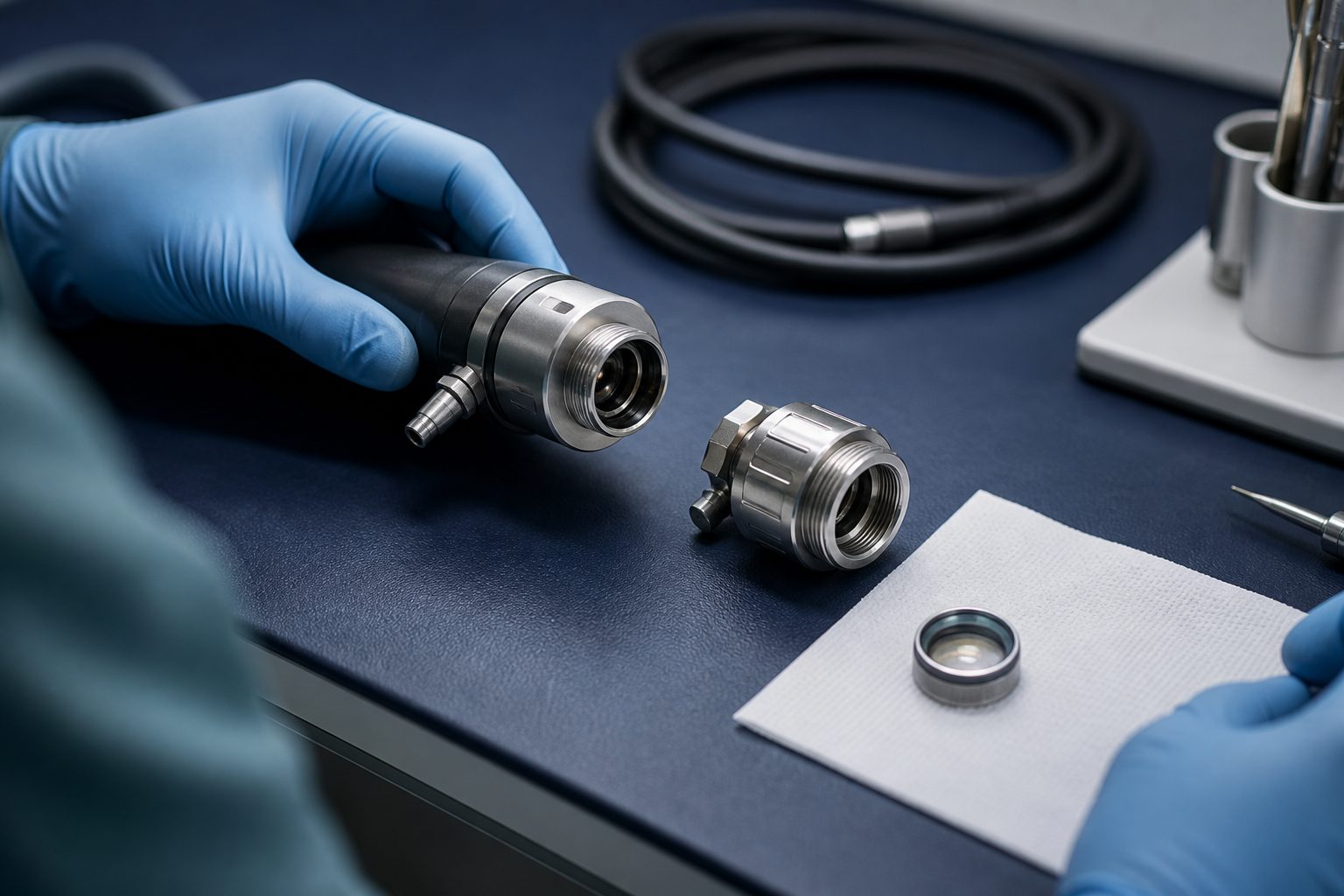
A light bundle is thousands of individual glass fibers. Each one carries light only while it is intact end to end. When a fiber breaks, that pathway is gone for good, and the bundle transmits a little less. There is no repair that mends a broken fiber, in a scope or in a cable. The only real options are to replace the bundle or to accept the current output.
That is why illumination loss creeps rather than fails. Nobody notices a one percent drop. The room notices when enough drops have stacked up that the surgeon reaches for the brightness control, and by then the bundle has been degrading for a long time. It also explains why the light source keeps getting turned up in some rooms and never comes back down.
Fibers break at bends, at crush points, and at the terminations. Cables get the worst of all three, which is why cables fail first and fail often. Scope bundles are better protected, but they still lose fibers at the bending section and inside the insertion tube, which is why a crush event shows up as a dim image as well as a bent tube complaint.
How to Check Light Output at the Scope Post With Your Own Eyes
You can do a meaningful inspection in the department without instruments. Disconnect the cable, hold the scope light post up toward a bright diffuse source such as a ceiling light, and look straight into the polished face of the post. Do not use a light source or a laser for this.
A healthy bundle looks like an even field of tiny bright points. A degraded bundle shows a peppering of dark dots scattered through it, each one a fiber that no longer carries light. A localized break shows as a dark patch, wedge, or crescent, and that pattern normally maps onto the dark area the surgeon reported in the field.
Do the same inspection on both ends of every light cable in the room. Cables that have been coiled tightly on a hook for a year are usually the worst offenders in the building, and they are also the cheapest thing in the chain to put right. Anything that looks scorched, cloudy, or pitted on the face needs cable retermination and repolishing rather than another case.
What Fiber Repair Involves on Flexible and Rigid Scopes
On our bench the scope and the cable are measured separately against reference transmission, so the quote names the component that is actually limiting the room rather than the one that was sent. If you send both together, that comparison happens here instead of in your OR.
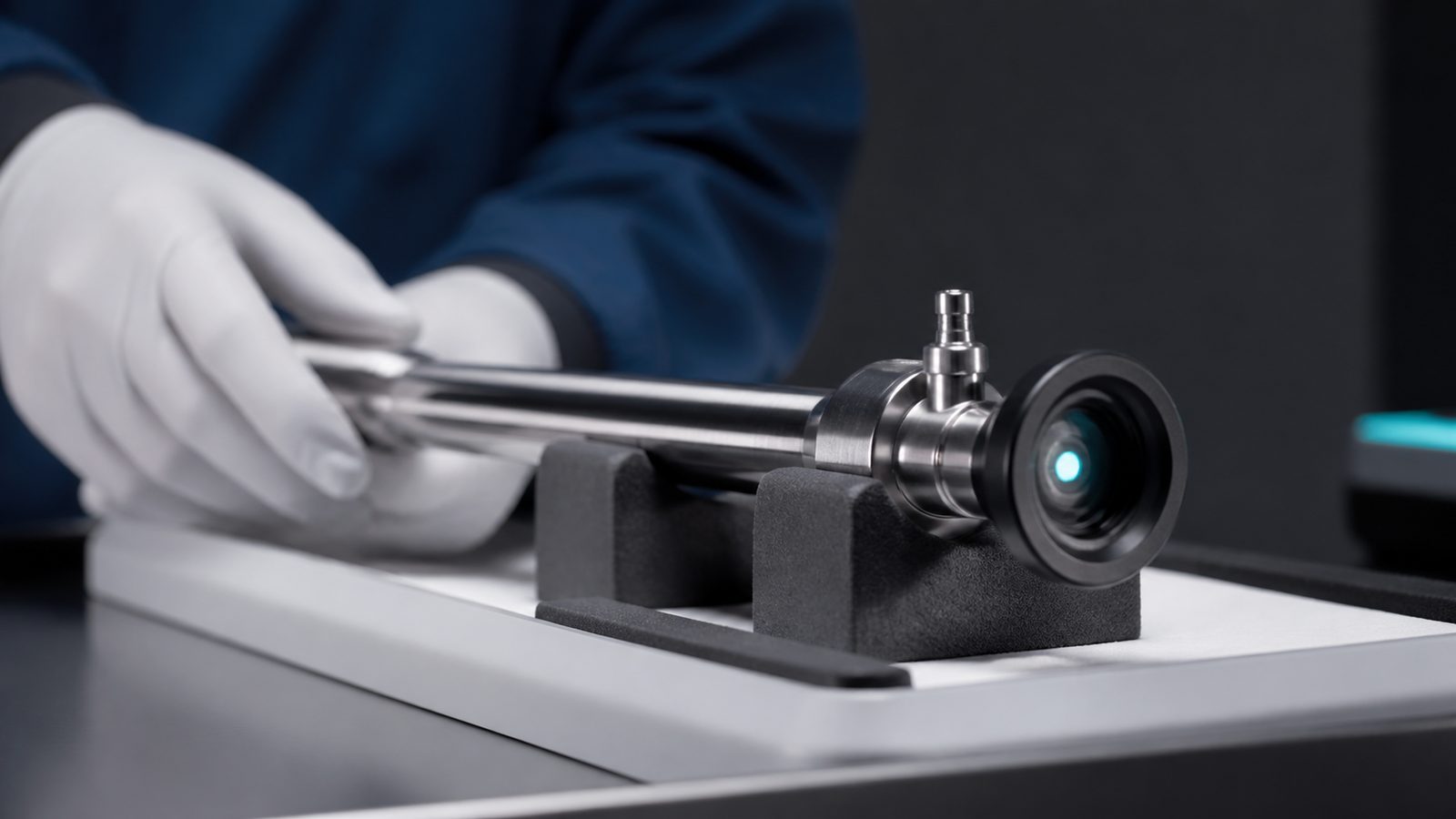
On a rigid telescope, illumination fibers run the length of the shaft around the optical relay, so bundle replacement is shaft level work and is usually quoted alongside any rod lens or straightening work the same device needs. That is routine rigid scope service, and it is common on laparoscopes that have spent years being handled by the shaft.
On a flexible scope, the bundles run from the light guide connector through the umbilical and the full insertion tube to the distal tip. Replacement is a longer job, and it is often quoted together with tube or tip work on the same device. If the field is dim and also hazy rather than simply dark, look at the distal lens and optical train page first, because that is a different fault wearing the same clothes. High volume gastroscope service brings us most of the flexible bundle work we see.
How it works
How Illumination Bundle and Light Fiber Repair Works Here
Transmission is measured rather than eyeballed, on the scope and on the cable, before anything is quoted.
Tell us what failed
Send the manufacturer, model, and what you are seeing. A photo of the damage helps but is not required.
We collect the scope
Courier pickup across Southern California, or ship the device in to our bench from anywhere in the country.
You get a written quote
We evaluate the device, document the failure, and price the repair. Nothing proceeds until you approve it.
Repaired, tested, returned
The device is repaired, leak and function tested, and returned with documentation for your records.
Questions we get
Light Output Questions From OR and Endoscopy Teams
How do we tell whether the scope or the light cable is the problem?
Can broken light fibers be repaired rather than replaced?
Is it safe to just turn the light source up until the scope is repaired?
How many broken fibers are too many?
Our light cables are all several years old. Should we test them all?
The image is dim and also cloudy. Is that the same repair?
Other Fiber Optic and Optical Faults We Repair
A poor image has several causes and they get confused with each other constantly. These are the neighbors of this one.
Leak Testing
The scope fails a leak test in reprocessing
Fluid Invasion
Fluid has entered the scope body or control section
Cracked Distal Lens
The image is starred, hazy, or partially blacked out
Bent Insertion Tube
The insertion tube is kinked, buckled, or will not straighten
Angulation Loss
The tip will not reach full deflection or feels loose
Channel Blockage
Air or water will not pass, or insufflation is weak
Biopsy Port
The biopsy port leaks, sticks, or will not seal
Get a Quote on Broken Light Fiber Repair
Send the scope and the cable together if you can. Testing them as a pair is how the actual fault gets found the first time.
Monday to Friday, 8:00 AM to 5:00 PM Pacific
Saturday and Sunday, closed
Mail-in repairs received any day
Serving Southern California with pickup and delivery, and the rest of the country by mail-in.