
Gastroenterology
Gastroscope Repair for Upper GI and Endoscopy Units
An upper GI scope lives a shorter, rougher life than the length of its insertion tube suggests. We repair bite damage, distal optics, suction channels, and valve seats on gastroscopes from every major manufacturer.
- Bite and crush damage on insertion tubes
- Distal lens and objective replacement
- Suction channel and valve seat work
- Leak tested on arrival and on return
Get a Free Repair Quote
Tell us what failed and we will send a written quote before any work begins. No charge for the evaluation, and no purchase order needed to get one.
Quote before any work
You approve a written quote before a technician touches the scope.
Free evaluation
We diagnose the failure and price the repair at no charge, even if you decline.
We come and get it
Pickup and delivery across Southern California, mail-in service everywhere else.
Independent, not the OEM
All major manufacturers serviced, without OEM exchange pricing.
By symptom
Gastroscope Failures We See From Upper GI Units
The faults below cover most of what arrives from an endoscopy suite. Match the symptom, then call with the model number.
Patient bite through the outer tube
A bite block that slipped or came out early leaves teeth marks that cut straight through the outer layer. The breach fails a leak test immediately, so the tube section is replaced and the internals are checked for fluid.
Distal lens abrasion
The objective window on an upper scope takes contact from teeth, forceps, and cleaning brushes. Scratches scatter light and wash out the field. We replace the lens and inspect the imager seal behind it.
Worn suction valve seat
The valve seat erodes from constant cycling and dried debris, so the piston no longer closes cleanly. Flow drops off well before the channel itself is blocked. Seat replacement restores the draw.
Slack angulation wires
Retroflexion in the fundus puts hard load on the steering wires on every case. Once they stretch, the tip trails the control knob and stops reaching full deflection. Wires are replaced and tension is reset.
Cracked bending rubber
The bending rubber ages, stiffens, and eventually splits at a fold. Once it is open the scope must come out of rotation before the next reprocessing cycle drives fluid into the control body.
Blocked air and water lines
Protein soil dries into the narrow air and water lines and restricts them from the nozzle backward. We clear the lines, replace the seats and nozzle if needed, and confirm flow at the tip.
Bite Damage and What It Does to a Gastroscope Insertion Tube
Upper endoscopy has one failure mode nothing else shares. A patient bites, the block shifts, and a scope that was fine ninety seconds ago now has a cut through the outer tube. Sometimes the tech sees it. More often it turns up in decontamination as a leak test failure with no obvious explanation until the tube is under magnification.
The urgent part is not the repair, it is the interval between the damage and the next reprocessing cycle. A breached tube that goes through a reprocessor carries fluid into the working parts of the scope, and a tube section replacement becomes a much larger job. Anything that has already reached that stage belongs on our fluid invasion recovery page rather than a routine queue.
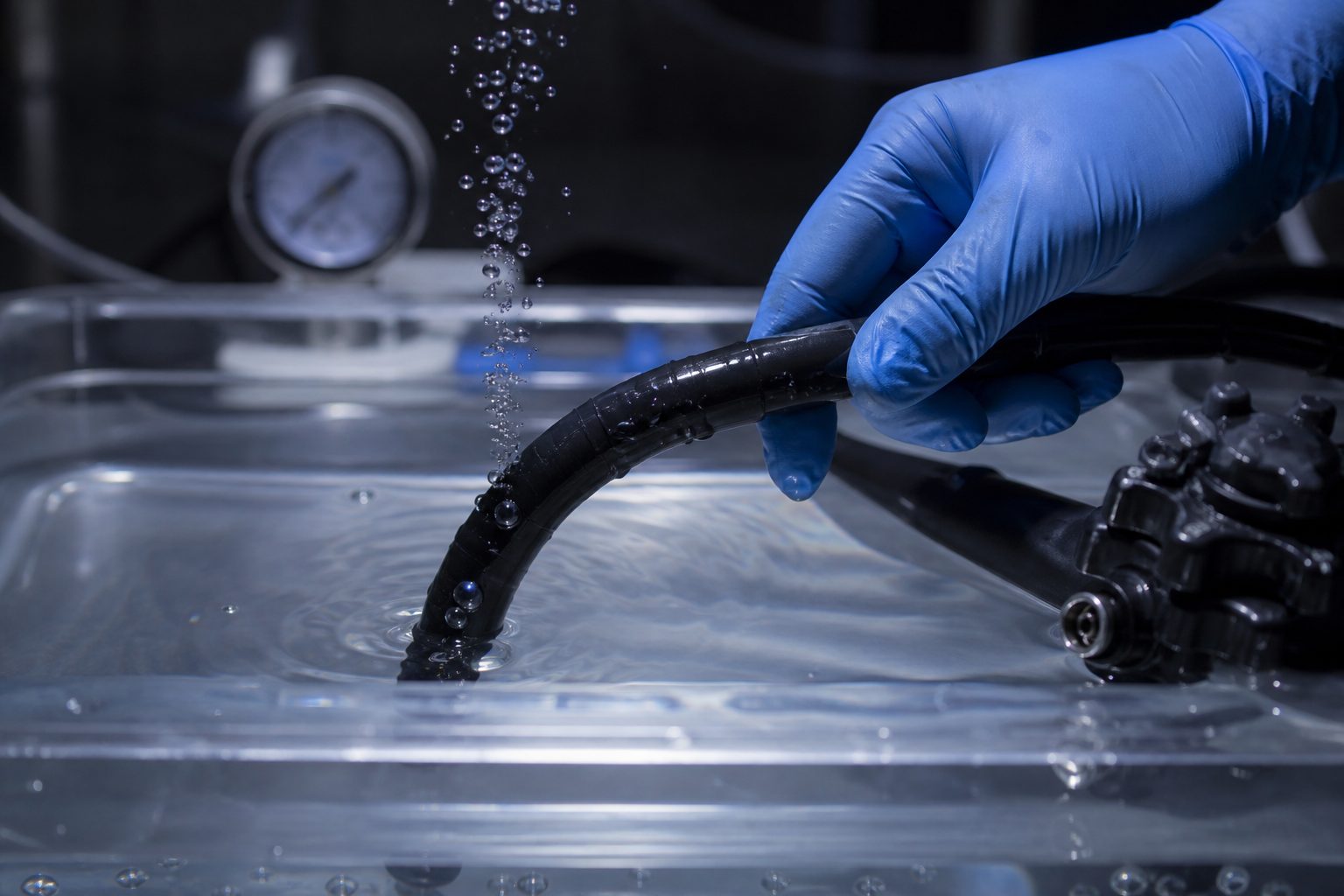
Every gastroscope we take in goes through the same intake as the rest of our flexible endoscope service line: leak test, channel patency, articulation range, then image.
Gastroscope Optics, Lens Scratching, and Lost Image Quality
Upper GI optics degrade in small steps. A scratch here, a brush pass there, and the field slowly loses contrast until someone finally says the picture is not what it used to be. Because it happens gradually, departments often replace the video processor or the monitor cable before anyone looks at the objective window.
We check the optics against a target rather than against memory, which separates a scratched distal lens from a broken illumination bundle from a light cable that has lost half its fibers. If the field is starred or partially blacked out, that specific pattern is covered on our cracked distal lens page. If the whole field is dim at full output, the cause is more often broken light fibers than a failing lamp.
Suction Valve Seats and Gastroscope Channel Restrictions
Valves get replaced constantly and seats almost never do, which is why weak suction is one of the most misread faults in endoscopy. The disposable valve is new, so the assumption is that the channel must be blocked. Often the seat under the valve has eroded far enough that the piston cannot close against it.
We test flow at the distal tip rather than at the connector, so a restriction gets located instead of guessed at. Where the line itself is the problem, the work is the same as any other air and water channel replacement. Where the biopsy port is leaking or sticking, that is a separate rebuild.
Most gastroscopes that reach this bench carry an Olympus badge or a Fujifilm and legacy Fujinon nameplate. Both go through the same evaluation, and neither relationship is an authorized one. We are independent by design.
Upper GI Scope Faults That Get Misdiagnosed in the Department
A scope that is described as broken usually has two problems, and only one of them is the one that got reported. Weak suction and a scratched lens travel together because both come from the same year of heavy use. Loose deflection and a cracked bending rubber travel together because both come from retroflexion load.
That is the case for a full evaluation instead of a symptom based fix. You get the whole condition report, including the items you did not ask about, and then you choose what to authorize. Departments running upper GI volume usually run lower GI volume too, so a pickup often includes a colonoscope with stretched cables or a side viewing duodenoscope on the same trip.
How it works
How Gastroscope Service Works From Start to Finish
You see the diagnosis and the price before anyone commits your department to anything.
Tell us what failed
Send the manufacturer, model, and what you are seeing. A photo of the damage helps but is not required.
We collect the scope
Courier pickup across Southern California, or ship the device in to our bench from anywhere in the country.
You get a written quote
We evaluate the device, document the failure, and price the repair. Nothing proceeds until you approve it.
Repaired, tested, returned
The device is repaired, leak and function tested, and returned with documentation for your records.
Questions we get
Gastroscope Repair Questions From SPD and Endoscopy
A patient bit the scope. Can it still be repaired?
Suction is weak but the channel brushes through cleanly. What else could it be?
The image looks washed out. Is that the scope or the light source?
Do you need the video processor to evaluate the scope?
How do we get the scope to you?
More Flexible Scope Repair Across GI and Beyond
The other devices that come through on the same pickup, handled by the same technicians.
Get a Free Quote on Gastroscope Service
Send us the manufacturer, the model, and what you are seeing. The written quote comes back before any work begins.
Monday to Friday, 8:00 AM to 5:00 PM Pacific
Saturday and Sunday, closed
Mail-in repairs received any day
Serving Southern California with pickup and delivery, and the rest of the country by mail-in.